
A selection of 1,000 contacts rarely costs 1,000 credits, and the difference is always in your favour. Three mechanics explain it.
- Invalid and unverifiable addresses are filtered out before delivery. They never reach your file and never cost a credit. A segment with weak coverage simply produces a smaller file for less money.
- Re-verifying a contact you recently checked is free. Exporting an overlapping slice of the same list twice does not bill you twice for the same recent check.
- Catch-all and risky addresses are an explicit opt-in. The default export filter is valid only. If you left the default, those rows are absent and unbilled.
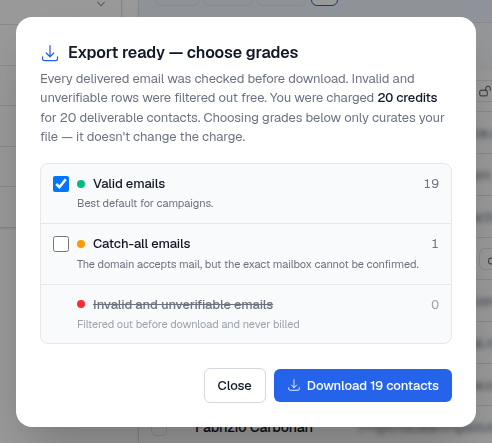
The export summary shows both numbers - what was selected and what was delivered - so the gap is visible rather than something you have to reconstruct from a balance.
If the gap is much larger than you expected, that is a targeting signal rather than a billing one. Very narrow filters, unusual job titles, or small companies in low-coverage countries all reduce the deliverable share. Widening one filter at a time usually restores it.
The same rules apply identically through the API, MCP and CLI. Agents get the same discount without doing anything special.